You’re Not Broken, You’re a Prototype
The case for your possible evolution in a state-obsessed world.
You are probably not new to “working on yourself.”
You know what a trauma response feels like. You have language for anxiety, shutdown, attachment, parts. You have screenshots of nervous system diagrams on your phone. You might even be the person your friends come to for “psychological” takes.
And still, life repeats.
Same pattern, different partner.
Same burnout, different job.
Same shutdown, different therapist.
Same late-night question: “Why does all this insight still not add up to a different way of being.”
Most modern psychology is built to answer a different question:
“What are humans like, on average or baseline, right now?”
Useful question. It gives us diagnoses, treatments, tools. It helps us suffer less and function better. I am absolutely here for that.
But it leaves almost untouched another question that quietly haunts a lot of people:
“What is a human actually capable of becoming?”
That second question is where this idea of “possible evolution” lives. And yes, we need to define that word clearly or it turns into vague woo-woo jargon.
When I say evolution here, I do not mean “unlocking cosmic powers” or becoming a flawless Zen adult. I mean something very specific and very boring-sounding:
• a more stable capacity to notice yourself in real time
• a little more freedom from your most mechanical patterns
• a more coherent inner “you” that can actually coordinate your different parts
• a nervous system that is less easily hijacked and more able to stay present
That is it. If anything mystical ever grows on top of that, great. But the foundation is painfully practical.
To talk about that, we need one uncomfortable sentence: most of us are prototypes pretending to be finished products.
A prototype is a working draft. Some parts function well. Some parts break under stress. When it glitches, the point is not to shame it. The point is to learn how it is built.

Not broken, just a current build that glitches under stress and isn’t the final version.
Viewed that way, a lot of what we call “my issues” look different.
The way someone shuts down when they sense disappointment. The way they over-perform at work and then collapse at home. The way they say “yes, of course” while an inner part is screaming “please no.” The way they lose their own priorities the second someone else has a need. Those are not random moral failures. They are the current wiring doing what it learned to do.
Here is the part culture mostly skips. That wiring is not one thing.
We talk as if there is one self inside, one “I,” one will. But if you watch your day honestly, it is obvious there are many.
There is the version that signs you up for a 6 a.m. routine.
The version that absolutely refuses to get out of bed.
The version that wants intimacy and vulnerability.
The version that cannot tolerate being that exposed.
The version that wants to be kind.
The version that wants to burn it all down.
Each one says “I.” Each one believes its view is the whole truth while it is in charge. We do not notice the switches because we have one body, one name, etc.
From a prototype lens, this is not pathology. It is adaptive. One nervous system had to survive wildly different rooms, so it grew different operators.
The problem is not that we have many “I”s. The problem is that there is not yet a solid, consistent “someone” who can see them, include them and choose who gets the mic when.
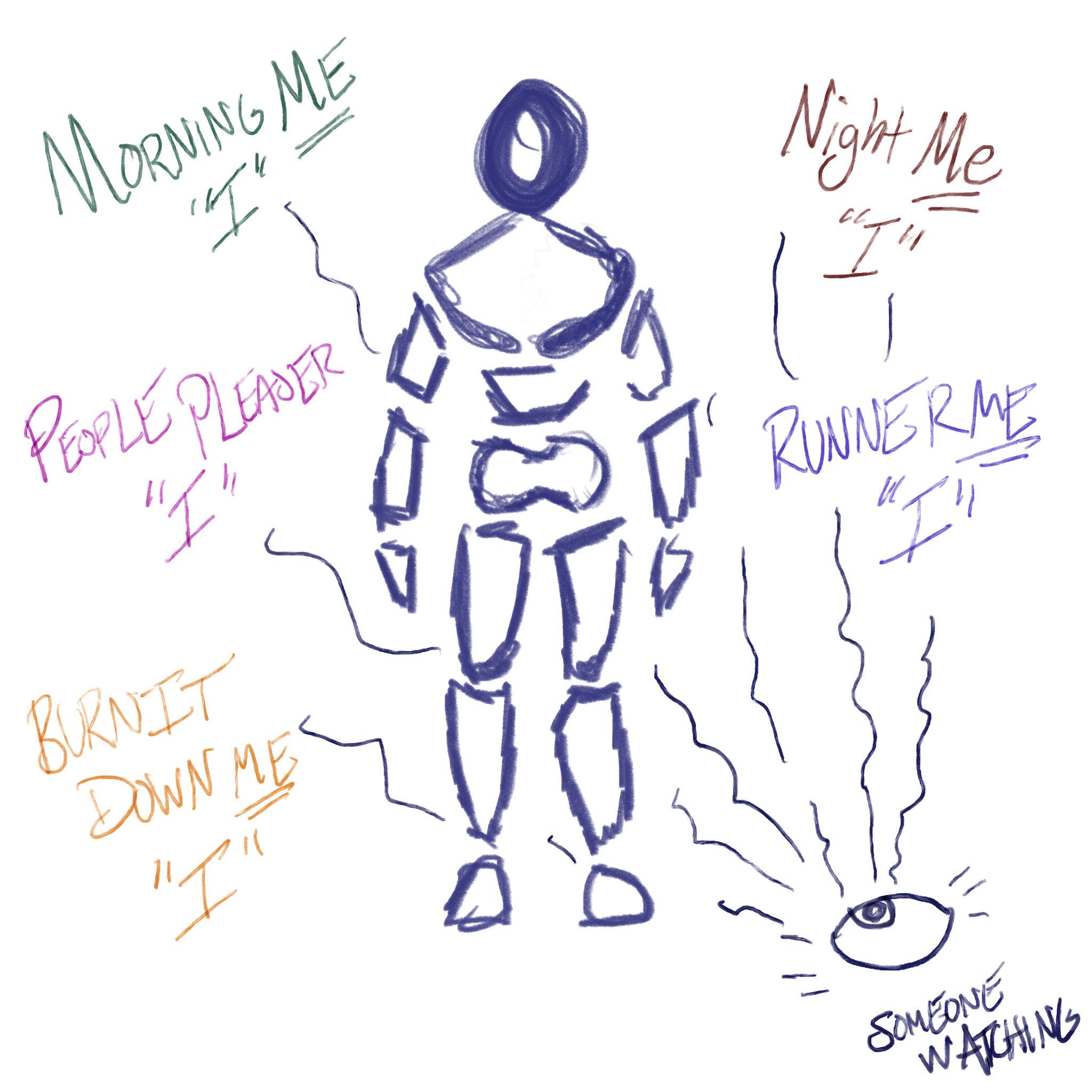
We don’t have one single “I” — we rotate through Morning Me, Night Me, People-Pleaser, Runner Me, Burn-It-Down Me, while a quieter awareness is always capable of watching them all.
That missing “someone” is what I mean by a higher level of functioning. Not a better personality. A more stable position of awareness.
Right now, most people touch that position only in flashes. A moment in an argument where they suddenly see themselves from the outside. A breath in a parking lot where they feel their feet and realise, “I am about to repeat the same script again.” A therapy session where, for ten minutes, they feel strangely more “here” than usual.
Those flashes matter. But they are not yet a baseline. They are like random upgrades that never get installed.
Here is the next uncomfortable sentence: there ain’t is no automatic update.
Bodies grow. Personalities form. Skills and knowledge can stack. That is the default package. Beyond that, nothing guarantees we will deepen.
Loosely speaking, three things can happen after that baseline is built.
We live and die at roughly the same inner level, just with more stories and coping strategies. We slowly lose even the capacities we had, under the weight of stress, avoidance, addiction, bitterness. Or, rarely, we develop qualities that do not appear by accident: steadier attention, cleaner honesty with ourselves, more real choice.
Those do not come just from time. They come from two things that are simple to say and hard to live: sustained effort and the right kind of help.
Effort here does not mean white-knuckling or self-hate. It means treating your own life as a lab. Watching your actual behaviour, not your fantasy self. Getting curious about your automatic reactions instead of justifying or attacking them. Practicing tiny interruptions of your most rehearsed patterns.
Help means contact with people, practices and environments that live from a slightly clearer, kinder centre of gravity than your current default. Not because they are “above” you as humans, but because their prototype has built some functions yours has not yet built. Being around that stretches you. (Good therapy, solid community, certain practices can do this. So can a very honest friend who refuses to collude with your self-deception.)
Let’s name one of the biggest obstacles to this kind of evolution, because it is not ignorance. It is lying. Not dramatic lying. Ordinary, socially acceptable, internal lying.
Saying “I know” when we do not.
Talking as if we are conscious most of the time when we are mostly on autopilot.
Claiming virtues (“I am very self-aware,” “I am so compassionate,” “I always show up”) that do not survive honest observation.
Building firm opinions about life, God, purpose, or even our own motives, on very thin evidence.
The point is not to shame anyone for this. It is to say: real psychology starts when we stop doing it.
If psychology is self-study, then the first task is sorting what is real in us from what is fantasy, performance or wishful thinking. That is unglamorous work. It is also strangely relieving. You no longer have to hold up a fake image of yourself to yourself.
Another missing distinction that helps here is the one between essence and personality.
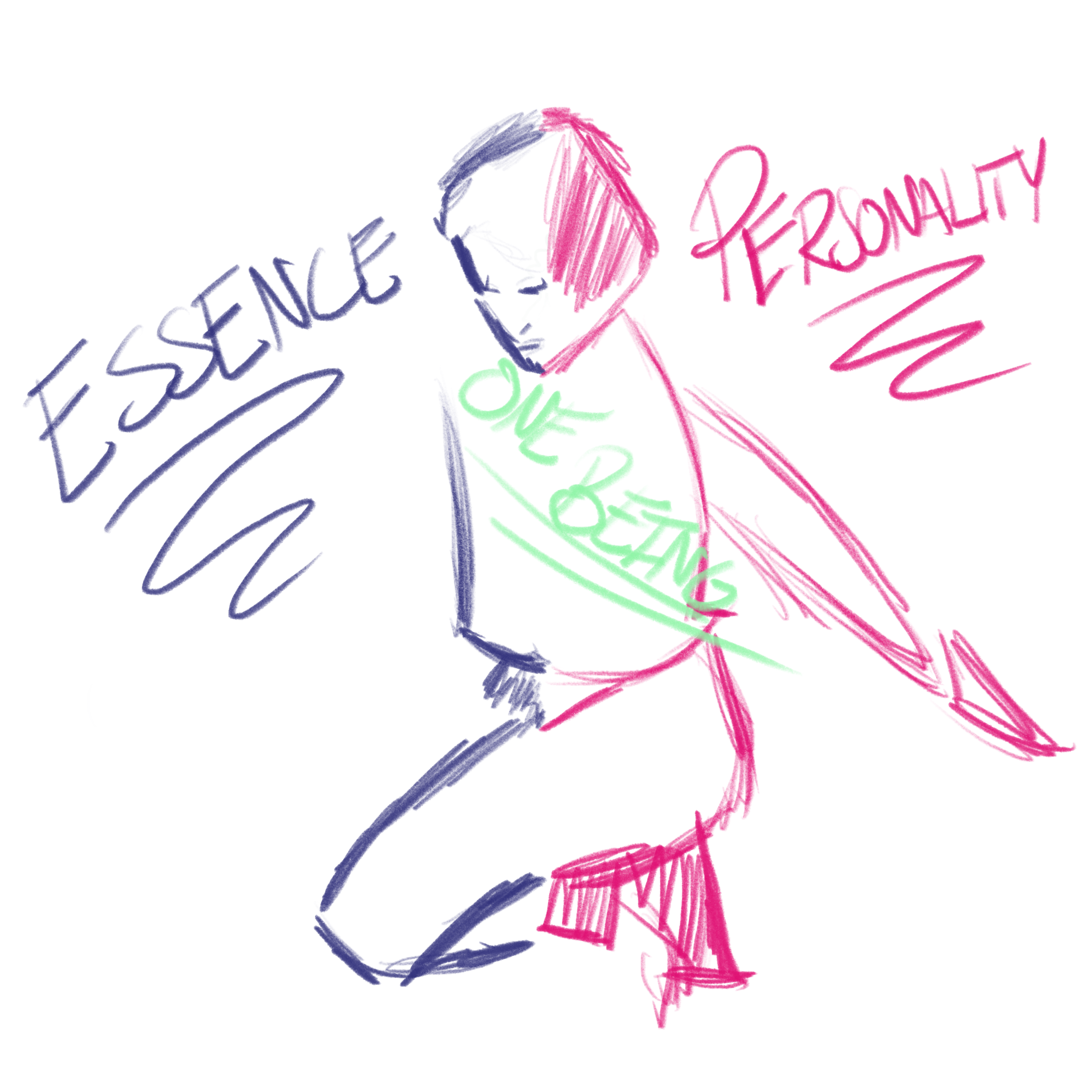
Essence and personality live in the same body; the work is not to erase personality, but to let essence lead while both stay part of one being.
Essence is the raw material we show up with. Basic temperament, natural sensitivities, the way a child lights up around certain things before the world has much say. Personality is everything we pile on top to survive and belong. Opinions, roles, masks, coping styles, the flavour we learn will get us approval or at least keep us from being hurt.
In a healthy arc, essence keeps growing and personality is a flexible costume in service of it. In real modern life, personality often takes over the whole house. Essence stalls early, especially in people who had to arm up fast, and personality grows huge: identity, aesthetic, take, stance.
The cost of that takeover is subtle. We start to like what is bad for us and dislike what is good. We chase what feeds the personality (image, status, comfort, numbness) and avoid what feeds the essence (depth, effort, contact). We feel more polished and less real.
When you put all of this together, “possible evolution” stops being a vague slogan and becomes pretty darn concrete.
It looks like:
• gradually building a more stable inner “someone” who can see and coordinate your many “I”s
• telling fewer lies to yourself about what you are like and what you actually do
• letting essence have more say in your choices than personality
• training attention the way you would train a muscle, so it does not collapse at the first sign of discomfort
None of that will get you a halo. But it will, slowly, change the kind of days you have.
At this practice, this is the deeper project under all the talk about states, movement and the nervous system. Not just “how do we feel less awful” (important), but “how do we become more accurate, more present, more internally grown-up prototypes over time.”
You are not broken. You are unfinished.
The point is not to pretend you are already some fully realized being. The point is to stop treating your current build like a final product and start relating to it as a live draft you can actually work with.
If there is one question to carry from this, it might be this: “Am I willing to treat myself less like a brand to maintain and more like a prototype to study, understand, and care for?”
If the answer is even a shaky “maybe,” you are already standing in a different place than the one your patterns were built in. That tiny shift in stance is where possible evolution actually begins.