Same Life, Different Floor
Why fast-furnishing your life never changes the structure underneath
Most of us have had a “new life” moment.
New city, new couch, new job, new routines. The boxes are unpacked, the lighting is better, the vibe is different. For a few weeks, it even feels like a full nervous system upgrade.
Then, slowly, the old feelings start showing up in the new rooms.
The same anxiety under a different ceiling.
The same shutdown on a different sofa.
The same arguments in a kitchen with nicer tiles.
From the outside, everything changed. On the inside, it feels suspiciously like the same life on repeat.
Meanwhile, out in the world, we have an actual fast furniture crisis. In the US alone, an estimated 9 million tons of furniture are dumped in landfills every year. That is roughly 5 percent of everything heading into landfills, just in tables, couches and dressers, many of them made from cheap particleboard that cannot be repaired or recycled. A lot of it was bought to make a place feel fresh, only to be discarded a few years later.
We are doing outside what we are doing inside. Constant refurnishing, almost no structural work.
So let us talk about the structure.
You can think of your inner life as a building with multiple floors.
On some days, you wake up on a low floor. On that floor, everything feels closer to your face. The email is not just an email, it is a threat. The neutral comment from your partner feels like criticism. Your body is more on-guard. You are scanning, braced and already tired.
On other days, you are on a slightly higher floor. The same inbox, same partner, same bills. From this floor, you can still see the hard stuff, but you also see context. You remember you have handled things before. You can notice your reactions without believing they are the whole truth. There is a bit more room inside your chest.
The external facts did not change. The inner altitude did.
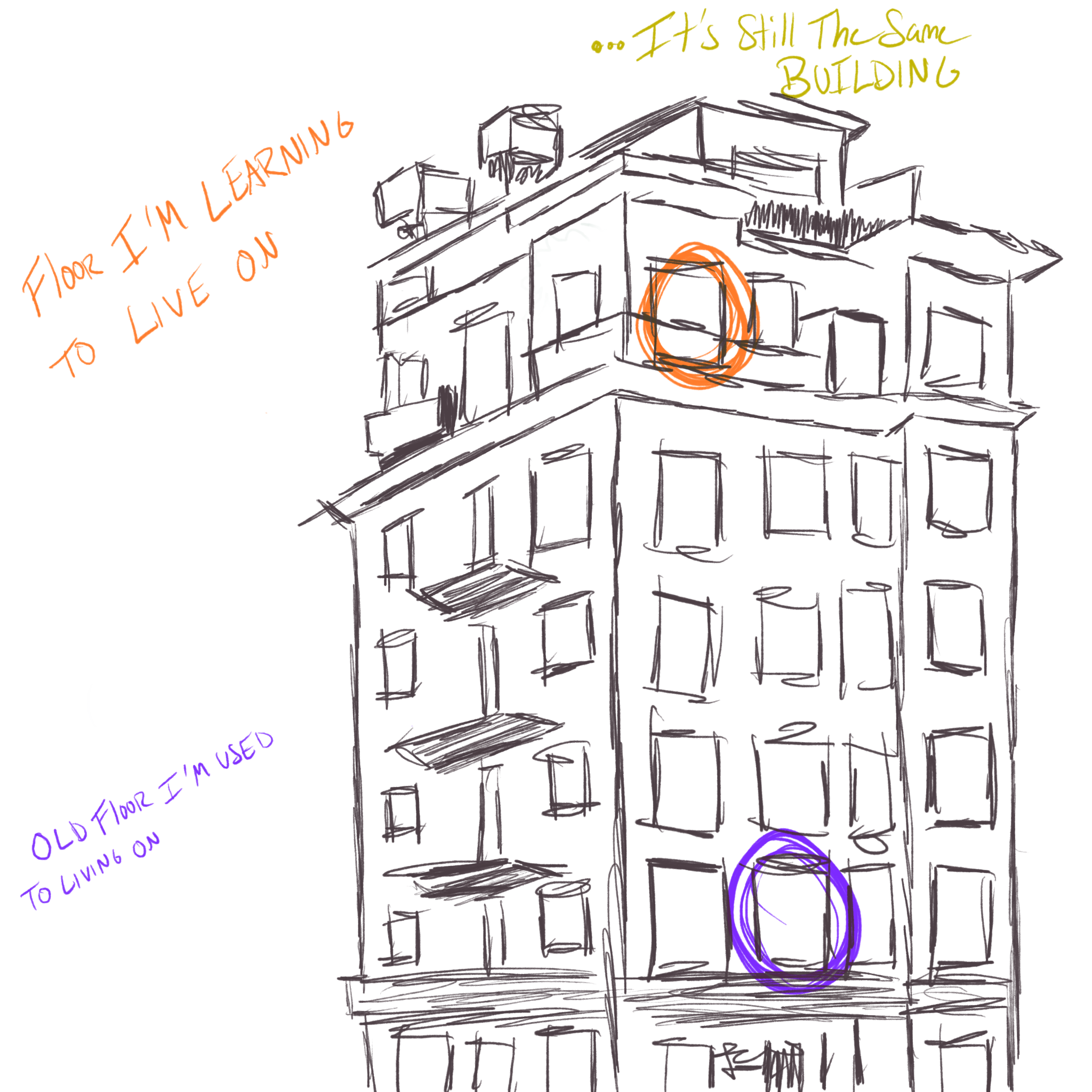
Same life…just a different floor.
By “floor” here, I mean the level of safety, presence and perspective your nervous system is operating from in a given moment. It is not mystical. It is the combined effect of your physiology, your history and your current state, all rolled into the platform you are standing on while you look at your life.
Most self improvement is about rearranging furniture on the same floor. New morning routine, new planner, new partner, new upleveled apartment. None of that is bad. It can help. But if the floor stays the same, the new arrangement eventually starts to feel old in exactly the same way.
Fast furniture is a perfect mirror for this.
Companies pump out cheap, trendy pieces made from materials like particleboard and laminates. They look good in photos, crack or sag after a few years, then head for the landfill where they add to pollution and waste. We get the hit of “I did something, my space is different” without any long term solidity.
Fast self improvement works the same way. Trendy tools, new systems, a big burst of motivation, then the crash. The nervous system does not actually feel safer or more capable. The floor did not shift. So everything in the room slides back into the grooves it knows.
This is not a character flaw. It is how a stressed organism protects itself.
From the perspective of your nervous system, familiar plus bad often feels safer than unfamiliar plus possibly better. At least the old pattern is predictable. At least you know where the exits are. The body will quietly lobby for the same floor, because new altitude means new sensations and new risks.
So you get this odd split. Consciously, you want change. Deep down, a lot of you wants to keep things recognisable. The result is fast furniture living. New scenery, same level.
If we take this seriously, “evolution” stops sounding like a cosmic upgrade and becomes something much plainer. It means spending more of your life on a slightly higher floor than the one your patterns were built on. Not all the way up some mythical tower. Just one or two floors above your usual.
On a higher floor, your history is the same, your traits are the same, your nervous system can still get activated or shut down. The difference is that there is more of you present when it happens. You notice that you are on edge instead of becoming nothing but edge. You see that you are spiralling, and a small part of you holds on to the fact that this has happened before and passed before. You catch one sentence of the story your brain is spinning and think, quietly, “I do not have to believe that all the way.”
That does not sound dramatic, but it is a structural shift. It moves your centre of gravity from inside the reaction to a position that can see the reaction.
In building terms, it is like reinforcing beams instead of buying a new lamp.
The work of raising your inner floor is slow, boring and very un-Instagrammable. It looks less like “new life launch” and more like learning to repair what already exists.
Sometimes it is literally nervous system work, teaching your body that it can come down from red alert without collapsing. Sometimes it is movement, finding out what it feels like to inhabit your spine, your feet, your breath in a new way. Sometimes it is the unglamorous discipline of tracking your real behaviour instead of your imagined self, catching how often you say yes when you mean no, how often you numb instead of rest, how often you talk instead of feel.
All of that builds floor.
It is also why certain kinds of therapy, mentorship or community are so powerful. Someone whose baseline is one floor higher than yours does not save you or fix you, but they give your system a live example of another altitude. Nervous systems learn through contact. You borrow their floor for a moment, and over time your own building starts to reconfigure.
If you want something to actually try, keep it small on purpose.
Once or twice a day, pause and ask yourself “what floor am I on right now.” You do not have to give it a number. Just feel into whether you are on the floor where everything is personal and urgent, or the one where there is a little space. Notice what your body is doing. Notice what kind of sentences are running in your head from that floor.
Do this especially when you are about to make a decision or have a conversation that matters. You might still say the thing. You might still send the text. The difference is that you are less fused with the floor you happen to be standing on.
You can also bring the fast furniture metaphor into the way you choose change.
Before you sign up for a huge new plan, ask “am I buying inner flat pack right now, or am I doing a piece of slow carpentry.” Flat pack change is the thing that looks good fast and falls apart under load. Slow carpentry is the unsexy repetition that makes the structure stronger. One is landfilled next season. The other is something you can live inside for decades.
The planet is quietly asking us to move away from fast furniture. Environmental groups have called out how cheap, short lived furniture, including pieces made from wood taken from old forests, is eating into ecosystems that will not grow back on human timelines. That conversation belongs inside our psychology too.
Sustainable living is not just about what we buy. It is also about how we build ourselves. Fewer dramatic overhauls, more attention to the floor we are standing on when we act. Less addiction to the high of “new,” more respect for what it takes to hold a higher level under stress.
You do not need a completely new life. You need enough inner altitude that your existing life stops feeling like the same old room with different cushions.
Same apartment, different floor. Same relationship, different floor. Same nervous system, slowly learning it does not have to stay pressed against the ground forever.
That is change you can actually live in.